PHYSICS
MEASUREMENT
Measurement:Is the process of assigning numbers to an event or
observation.
standard unit:Is the quantity chosen to be the refferences for other similar
units.
The standard unit must be:
-Invariable.
-Accesable.
Basic Fundamental Quantities.
Physical quantity:is any thing which can be measured. i.e Physical quantity is
the same as to say Quantity (B.Fundamental quantities).And this can be
catogorized into two major groups,
i)Basic (fundamental)quantities.
ii)Derived quantities.
Basic(Fundamental) Quantity.
Is the quantity which can exist their own,without depending on other
quantities.
The Fundamental quantities with their S.I unit
|
Quantity |
S.I unit |
Unit symbol |
|
Length |
metre |
m |
|
Mass |
kilogram |
kg |
|
time |
second |
s |
|
E.current |
ampere |
A |
|
Temperature |
kelvin |
K |
|
Amount of substance |
Mole |
Mol |
|
Luminous intesity |
candela |
cd |
Length,Mass,Time.
Length:Is the distance between two points.And the SI unit of length
is metre,(m).
Practical words for length.
-Distance.
-Displacement.
-Height.
-Depth.
-Width.
-Breadth.
-Radius .
-Diameter.
-Thickness.
-Circumference.
-Perimeter.
-Altitude.
-Light year. And alike.
The instruments used for measuring length:
-Vernier caliper.
-Tape.
-Meter rule .
-Telescope.
-Spectrometer.
-Micro meter screw gauge.
Appropriate Measuring instruments
Accuracy and Error.
Accuracy:Is the process of getting actual value (reading) by winning as many as
possible decimal places of a given unit. OR Is the amount or precise
measurement.
Error:Is the deviation from the true reading.
Sources of error
-Poor storage.
-Damage during use.
-Human Factors.
-Fault during manufacture.
Three Types of Error
i)Parallax error.
ii)Zero error.
iii)Instrumental error.
How to avoid error
Error can be avoided by taking as many as possible reading of a
particular value and determining its average.
Care must be taken
if an instrument is not calibrated from zero.The reading will be the difference
between initial value and final value.
Vernier caliper
Is the instruments which is used to measure the length to an accuracy of 0.1mm
or 0.01cm.
Application of Vernier caliper
-It is used for measuring thickness of book.
-It is used for measuring inside and outside diameter cylindrical rods.
Structure of Vernier caliper
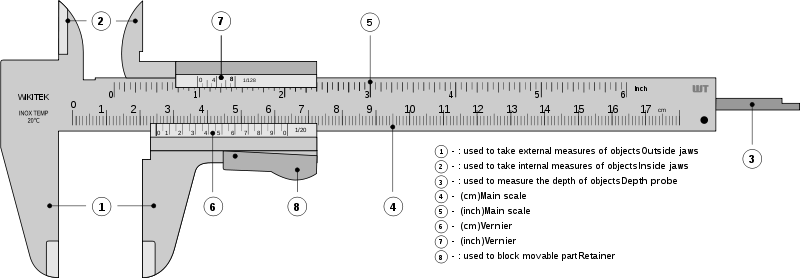
How to read a Vernier Caliper
i)Measure your specimen with either outside or inside jaws.
ii)Read all main scale which are before the first mark vernier scale.
iii)Identify the mark of vernier scale which is parallel to main scale.this determine the second decimals places of cm.
Examples
Micrometer screw gauge
Is the instrument which is used to measure the length to an accuracy of 0.01mm
or 0.001cm.
Application of Micrometer Screw gauge
i)It is used for measuring diameter and thickness of very thin wires and rods.
ii)It is used for measuring different thin and thickness of materials.
Structure of micrometer screw gauge
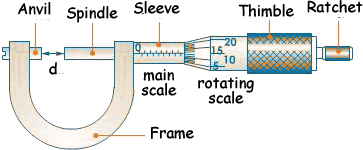
How to read Micrometer screw gauge
i)Place the object between the anvil and spindle.
ii)Rotate the thimble until the wire is firmly held between the anvil and the spindle.
iii)To take a reading first look at the main scale,that is last mark visible to the left of the thimble.
iv)Read and note down the value on the thimble that is just below the reference line on the sleeve.
v)Observe along the scale on the thimble ,above the reference line ,until you get the first mark on the thimble that coincides with a mark on the vernier scale on the sleeve.
vi)Read and note down the value on the sleeve.(Add the value in step iv, v, vi.)
Examples
Mass.
Is the quantity of matter in an object.And the S.I unit of Mass is kilogram (kg).
The instrument Used for measuring Mass.
-Scale balance.
-Beam balance.
-Digital balance.
-Lever balance .
-Triple Beam balance.
Time.
Is the measure of the interval between two events.And the S.I unit of time is second (s).
The instruments used for measuring time.
-Mechanical stopwatches.
-Digital stopwatches.
There are two types of stop watch.
i)Mechanical stop watch ii)Digital stop watch.
Some common Intervals of time.
1min=60sec. 1min=60sec.
1hr=60min. 1hr=3600sec.
1day=24hrs. 1day=86400sec.
Derived Quantities.
Is the Quantity which can not exist on their own,without depending on other quantities.
Quantity | S.I unit | Unit symbol |
Area | square meter | m2 |
Pressure | Newton per meter | N/m |
Volume | Cubic meter | m3 |
Weight | Newton | N |
Velocity | meters per second | m/s |
Work | Joules | J |
Power | Watts | W |
Volume
Volume: The amount of space occupied by matter. Sometimes volume known as capacity and the S.1 unit of volume is meter cubic (m3)
Volume of regular bodies.
- Rectangular block.
-Cube.
-Cylinder.
-Sphere.
-Cone and pyramids.
-Rectangle.
I. Rectangle:
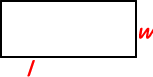
The volume is given by v
i.e v = h x
l x b
where, h = height
l = length
v = volume
b= breath
II. Cube:

the volume is given by v,
i.e V = h x l x b
but; h = l = b
because all sides are equal. so
v = h x h x h= h3
v=l xl x l = l3
v= b x b x b = b3
III. Cylinder
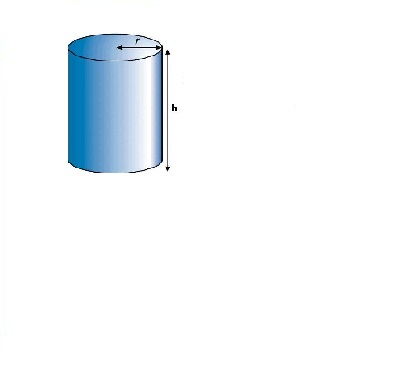
The volume is given by v i.e v =
area x height
v= πr2 x h
V=πr2h
IV. Sphere
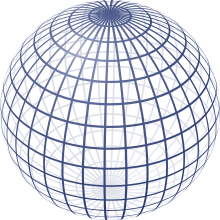
The volume in given by v
i.e v =
4/3 x πr3
v=4/3πr3.
V.Cone and Pyramids
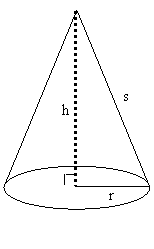
Their volume is given by,
V= 1/3 base x height
v= 1/3 x b x h.
v = 1/3 bh.
Determining the volume of irregufar object.
There are two ways of measuring volume of regular bodies,
i)Using measuring cylinder
ii)Using eureka can.
examples of irregular shapes are stones and beans.
1. Using a Measring cylinder
stes/produce.
i)Fill your water in the measuring cylinder.
ii)Record the initial volume of
water carefully (v1).
iii)Tie the object with a
string and immerse it into the cylinder.
iv)Record the final volume of water (v2).
v)The difference between the final anal
and initial volumes gives the volume of your irregular body. (stone )
Example I. When an irregular solid was immersed in 65 cm3 of water , the water level rose to 81 cm3. What was the volume of solid?
Initial Volume of water (V1)=65cm3.
Final Volume of water (V2)=81cm3
(Vs)=(81 - 65) cm3
(Vs)=16cm3
Therefore, the volume of Solid is 16cm3.
steps/procedure
ii)Tie the object with a string.
iii)Immerse the tied object in water completely.
iv)Then the object will displace some water which will be collected in the beaker.
(ρ)=m/v..............*
Density,ρ = 2g/cm3
Given;
-It helps in our Farming activities.
